Choosing the right lifejacket for children

Which lifejacket is the best for my child? What do I have to consider? Aren’t inherent lifejackets for children sufficient? At least these are free of service, can hardly be damaged when children are playing and are also less expensive than inflatable lifejackets. 

For choosing the right lifejacket you should know some basic information on the behaviour of children in water and their anatomy, which we would like to explain: 
 

Behaviour in water 

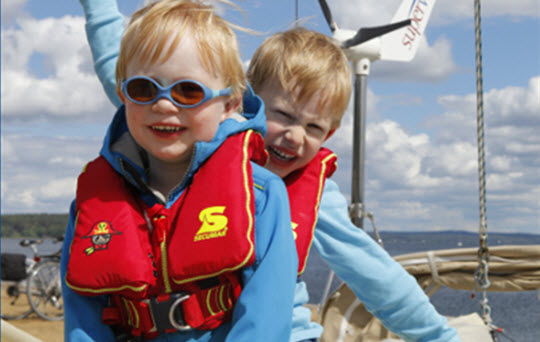
The first challenge results in the fact that children never act the same in water. If they are, for example, not used to water, they might cramp and even remain in water with their face downwards. Unfortunately, it does not only depend on children be used to water. The smaller a child is, the more a tendency to crawl applies, as children are curious to see where they are. Therefore, they turn on their belly. Thus, they work against the buoyancy in their lifejacket though of course they don’t do it consciously. If the children were unconscious, they would turn on their back. This scenario can only be tested in a laboratory with dummies [1]. Water tests with children can hardly be simulated. 

Anatomy of infants 

Infants additionally have an unfavorable anatomy affecting their water physical properties. Infants have a disproportionally big head which moves their centre of gravity further up, also affecting the buoyancy. This is a disadvantage for lifejackets, as their turning movement is affected unfavorablyUltimately the highest part, which is the head with its respiratory organs, needs to remain over the water surface. 

Furthermore, infants have disproportionally high adipose and “light bones” [2], which partially creates buoyancy in arms and legs. This is also a disadvantage for the turning moment of the lifejackets, as this requires a higher force to turn the children on their back. 

Finally, infants often still wear nappies, which also causes buoyancy at the wrong part of the body and affect the turning moment of the lifejacket. 

Inflatable versus inherent lifejackets

All this can finally only be prevented by placing the buoyancy round the neck. However, this is only possible with inflatable lifejackets. For infants this is only possible starting from the age of two years, e.g. with our product SECUMAR Mini. 

To bear in mind for inherent lifejackets for infants: They only offer limited performance. Important is that the children do not drown and remain visible at the surface. The recovery needs to be done as soon as possible. Anyway, infants wearing an inherent lifejacket are safer than those wearing none. 

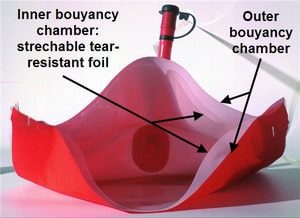
Finally, there is the argument that inherent lifejackets are more robust. Many parents see this as the final criterion for their children. Here we can retort, that our inflatable lifejacket SECUMAR Mini is fitted with an especially robust buoyancy chamber with DUO PROTECTtechnology, having self-healing properties. However, the Mini is still due for regular service, as also the inflation device and gaskets need to be checked regularly due to the fact that they are subject to ageing even if not worn. 

The performance of inflatable lifejackets is superior to that of inherent products by far. On the other hand, there are higher cost for procurement and maintenance. Apart from that the inflatable products activates with each fall into water. This might make them second choice for bathing, at the beach or in a rubber boat. Offshore, children should always wear an inflatable lifejacket. Especially as all children lifejackets have an integrated harness which allows to secure children with a lifeline at an attachment point, e.g. in the cockpit. Thus falling overboard can be prevented a priori. 

Conclusion 

No matter which kind of lifejacket parents choose – they need to accept compromises between performance and practical points unless they decide to buy both variants.  

Of course, it is understood, that responsible parents always stay near their children. 


[1] Even if our employees offer to test with their children, we do of course never test with unconscious children! For these scenarios we work with our Dummy B.A.M.B.I.

[2] Infants compared to adults have much more cartilage in their body. This is the result of the so-called growth zones in bones during the growing process. Thus, the bones of children in younger years are less compressed, which leads to a higher flexibility. The low density, however, implicates that children bones have less drift than those of adults.  


Can I switch off the automatic inflation device when I am taking part in paddling sports, and switch it back on again when I go sailling?

Yes, you can, as long as your life jacket is fitted with a SECUMATIC 3001 S or 4001 S type of inflation device. We carry a manual override for both of these inflation devices in our range.

Function: If the manual override is inserted, the function of the automatic inflation device is restricted to semi-automatic operation. That means, if the manual override is activated, the lifejacket can only be inflated by pulling the release handle.

Important note: In certain applications it makes scenes to use a manually inflated lifejacket. Sometimes it is even safer than using a fully automatic inflatable lifejacket. But in Europe, lifejackets are classified as Personal Protective Equipment (PPE). All PPE is approved and certified by an external, independent notified body. If a fully automatic lifejacket is modified to manual operation, this may effect the lifejacket approval. Therefore it is essential for your safety to follow the user instructions supplied with the manual override.


Can I take my inflatable lifejacket on a plane?

Yes you can. The IATA (International Air Transport Association) regulations allow for two inflatable type lifejackets, plus two replacement CO2 cylinders to be carried in either hand or checked-in baggage.

However, the authorities have left the final decision to individual airlines who have then deferred to each individual flight captain as to whether they comply with the regulations or not, so in reality it is down to the captain and the airport security staff, if they feel there is a security threat, to refuse to take the lifejackets.

In order to overcome this, you should notify the airline when booking the ticket so it can be entered into the ticket (electronically), that you will be carrying lifejackets and also if possible obtain written confirmation to obviate confusion at Check-in or Security.

Furthermore the national air transport authorities ask customers not to berate their call-centre staff as the problem lies solely with the individual airlines and you will need to get their permission.


The relevant IATA guidance is as follows

A. Relevant IATA Dangerous Goods by Air Regulations
IATA DG regulations state that a lifejacket fitted with no more than 2 cylinders and no more than 2 spare cartridges may be carried in carry-on or checked baggage with the approval of the aircraft operator. Although most individual airlines state their policies on carriage of cylinders on their websites, these policies are not being applied consistently by their staff.
Failure to declare hazardous material to the airline is a criminal offence. Even if airline policy is to accept the specific IATA guidance, any passenger may be denied boarding unless all cylinders have been removed from baggage and confiscated.


For full details see

It is also advisable to remove any CO2 cylinder from its firing head prior to checking in or passing through customs.

Do your kayaks qualify as life-saving equipment which can be used as a substitute for life rafts?

Under no circumstances whatsoever should kayaks be used as a life-saving device. Life rafts are the final possible option in an emergency situation. Only they should be used for this purpose.

Will I be able to get into a life raft at all in my inflated 275 N life jacket which is so bulky?

It is always difficult to get into a life raft. However, there are entry ramps for greatly improved entry. If there is an entrance which is large enough, then it should be possible even for people who are not practised in doing so to enter.

How to buy SECUMAR products?

Lifejackets should not be bought off the rack. They need to fit the for the purpose and the person. As this requires consultation, SECUMAR products are exclusively sold through authorized dealers.

To find a store near you that carries SECUMAR products, first select your country, then select by postal code or region.

Or contact us.

What is the white plastic part on the sport kayak for?

If you paddle in different places, you may need various kinds of permits. The plastic part allows one to write any necessary identification or permit numbers on the boat.

What is a Newton?

A Newton is a unit in which buoyancy is measured.
150 N (Newton) is approx 15 kg or approx 15 Liter.

What is the life expectancy of a kayak?

This depends, of course, on how well the kayak is maintained. On average, however, you can expect it to last 12-15 years.

Why do you have blue and dark-coloured life jackets? They can’t be seen very well in water, can they?

We also have life jackets in red, silver, grey and also rainbow-coloured colours. What is important is that the inflated life jacket is in the international signalling colour orange or yellow. This is the case with all of the SECUMAR life jackets.

Do I have to look after or store the kayaks in any particular way?

They do not need any special care. They should be cleaned once in awhile and over the winter you should partially inflate them and store them in a dark place.

Is the polyvinyl chloride environmentally conscious?

Polyvinyl Chloride (PVC) is harmful only when burned. Otherwise the PVC is extremely robust and durable and therefore is no threat to the environment.

I go sailing and my weight is over 200 lbs. ( 90 kg ), which life jacket do I need ?

Your weight is only of marginal interest to us. What is important is what kind of clothing you are going to be wearing. In most cases today, we recommend life jackets with 275 Newton. We do this for the following reasons:

As a rule, a life jacket has a life time of 10 to 15 years. However, you do not know today which items of clothing you will have acquired in the next few years or into which cold waters you will dare to venture into in the next 8 years. But since the weight of a 275N life jacket is not substantially greater than that of a 150N life jacket, and the price difference is likewise insignificant, even today we are recommending tomorrow's standard.

Are spare parts available?

Yes, of course. As the manufacturer, we have a legal obligation to hold stocks of spare parts for 7 years after they are produced.

Are the kayaks easy to maneuver and do they have good tracking qualities?

This depends on the model you buy. Easy maneuverability and good tracking are two qualities that are difficult to find together. A boat which is easy to steer most likely doesn't have optimal tracking qualities. However, we do our best to combine these two properties for a sufficient solution. Our white water kayak, however, has excellent maneuverability which compromises the tracking qualities.